
Incident RCA: Lineman Shocked by Improperly Backfed Portable Generator
A severe shock incident caused by a homeowner running a portable generator without a transfer switch, sending deadly voltage back onto the grid during storm restoration.
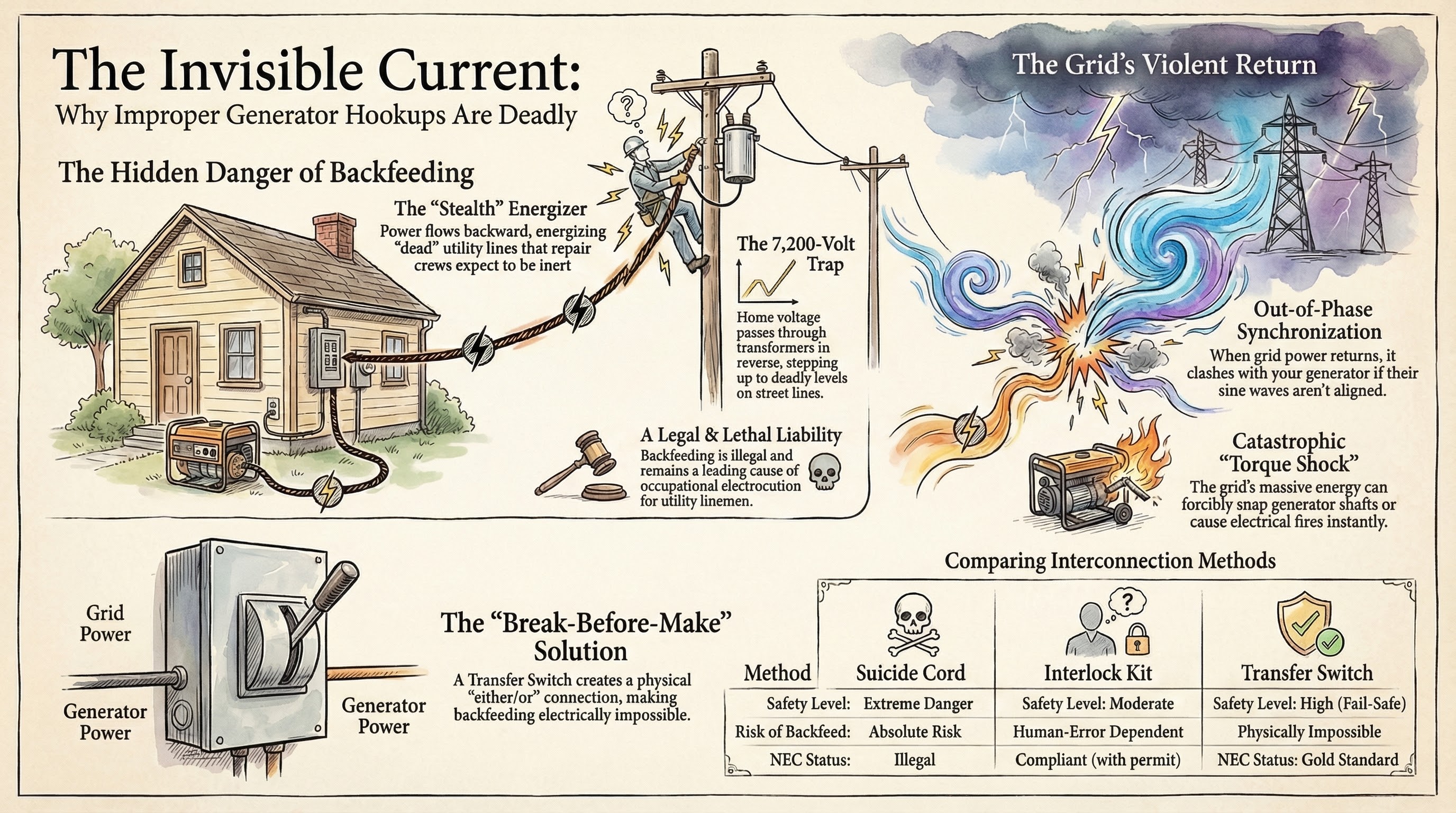
Incident Overview
During the early hours of post-storm restoration, a primary distribution line had been de-energized to allow crews to safely remove fallen trees and repair downed conductors. Before applying personal grounds, a journeyman lineman made contact with a supposedly dead conductor and received a severe shock. He was thrown backward and sustained secondary fall injuries, but fortunately survived due to swift action from his crew.
The Immediate Danger
The crew had correctly verified the main feed from the substation was open (de-energized). However, the line was unexpectedly re-energized from the load side. A local homeowner, attempting to restore power to their house, plugged a running portable generator directly into a dryer outlet without a transfer switch.
Guess the Root Cause
Why did the supposedly 'dead' distribution line suddenly become energized?
Root Cause Analysis (RCA)
Direct Causes
- Improper Backfeeding: The homeowner bypassed all established safety and building codes by “backfeeding” their home’s panel. This caused the generator’s 120/240V output to travel backward through the service entrance.
- Reverse Transformer Action: The pole-mounted distribution transformer acted in reverse, stepping the 240V back up to primary distribution voltage (thousands of volts) and fully energizing the downed line.
Systemic/Procedural Failures
- Failure to Test Before Touch: The lineman skipped the critical “test for absence of voltage” rule immediately prior to handling the conductor, assuming it was dead because the main feeder breaker was open.
- Delayed Grounding: Personal grounding clusters were not applied immediately after the main isolation steps. If grounds had been in place, the high backfed voltage would have been shorted to the neutral/ground, instantly tripping the generator’s breaker and protecting the worker.
Corrective Actions & Key Takeaways
- Verify and Treat as Energized: Never assume a line is dead during an outage. Countless residential generators are improperly connected during grid failures. Always verify absence of voltage (Live-Dead-Live) before every single interaction.
- Immediate Personal Grounding: The only absolute guarantee of safety on a distribution line is placing personal protective grounds securely on all phases between the worker and every possible source of energy—including the load side.
- Public Education: Continue pushing aggressive local community outreach regarding the immense, fatal dangers of bypassing transfer switches when deploying emergency generators.
Community Discussion
Join the conversation. What are your thoughts on this incident or safety topic?
Comments will appear here once the Giscus GitHub repository is linked.