
The Harmonic Your Neutral Can't Handle
Why 277V and 347V neutrals burn in industrial facilities, and why you may be looking in the wrong direction.
1. The 347V / 277V - Know Your Neutral?
Almost every medium to large Canadian commercial and industrial building wired between 1970 and 2015 ran interior lighting on three phase 600Y/347V four wire circuits — with each one of the phase branches sharing one neutral. The US analog at 480Y/277V uses 277V lighting on the same topology. Copper saved at install. Supposed to be efficient.
An energy services contractor pitches an LED retrofit. The math is clean. Same lumen output at a quarter of the wattage, payback in eighteen months. A weekend crew swaps the fixtures.
What changed: the load on each phase dropped sixty to seventy-five percent. The energy bill confirmed the win.
What also changed: the harmonic profile of every branch went from low-distortion magnetic-ballast load to high-distortion SMPS load. Third-harmonic content multiplied. The neutral that had been running comfortably under fluorescent loading now carried triplen current that arithmetically added from each of the three phases.
No phase breaker noticed. The phase ammeter looked balanced and well below trip. The neutral kept heating. Insulation aged faster than design assumed. Eventually something gave.
Open neutral at 347V is lethal, not just hot
At 347V line-to-neutral, a disconnected or opened neutral on an energized circuit turns the neutral into another hot conductor. An electrician, if holding the neutral and making contact with a ground can create a new parallel path — a fatality risk, not just a fire risk. Always ensure and verify removal of power when working on this type of system! Do not confuse this with an open neutral at the transformer wye point of the four wire system. That is a different scenario which could potentially cause an even higher voltage potential causing damage to equipment etc. Note that this type of transformer open neutral scenario in a 240V/120V single phase system can potentially cause both larger and smaller voltages to appear on the 120V wired equipment.
277V on a 480Y/277V system carries the same risks at slightly lower voltage. Public reporting documents an apprentice electrocuted contacting an energized 277V conductor on a high-rise build, and a journeyman who survived contacting an open 277V ballast neutral only because the shock threw him clear of the ladder. An older 277V ballast creates a series voltage rise across the open neutral that can in turn create a fatality risk.
The Canadian retrofit precedent
The closest documented Canadian incident in this product family is two warehouse fires that occurred within roughly one week of each other, both involving fluorescent fixtures retrofitted with LED tubes — an even more aggressive retrofit than full driver replacement, where the existing electronic ballast tries to drive an LED tube it was never designed for. The fires were attributed to high resistance and thermal breakdown at the LED tube where ballast output was incompatible with the load.
That’s a different mechanism than triplen-neutral overload. Same systemic story — an LED retrofit, presented as a simple energy upgrade, silently introduced an ignition source nobody re-engineered for. Both belong to the same product family of retrofits that change more than the watts.
And the lighting panel isn’t where this stops. The LED retrofit signed off on last quarter — or the rack of servers and UPSs you’re adding to your control and business data systems this quarter — may have re-engineered the fire risk in your panel. Here’s why.
2. Beyond Lighting
The same physics shows up wherever a wye panel feeds heavy single-phase electronic loads — IT, control, UPS, business data, production systems.
A power quality crew on the US East Coast clamped a true-RMS meter onto a transformer neutral feeding about twelve hundred switched-mode power supplies. The fundamental current registered seventeen percent. The third harmonic registered one hundred percent. Three 150 kVA dry-type transformers, fed from a 500 kVA UPS, were running visibly hot. Nobody had considered the system design for harmonic content.
The transformers got swapped. The neutrals got doubled. The fire never happened — that time.
That panel ran 208Y/120V — a three-phase wye system feeding loads line-to-neutral. The physics is identical at the two voltage classes Canadian and US industrial electrical work runs on every day: 600Y/347V in Canada and 480Y/277V in the US. Single-phase nonlinear loads on shared neutrals stack triplen harmonics that don’t cancel, and the conductor sized for the phase ampacity is the one that cooks.
3. Why the VFD Is the Wrong Suspect
After a neutral conductor melts, the first thing the post-incident meeting does is point at the biggest drive in the building. The mill motor VFD. The conveyor drives. The pump-station soft start. Big drives, big harmonics — must be the cause. Not
A standard 6-pulse three-phase VFD connects only to L1, L2, and L3. It has no neutral terminal. It pulls power phase-to-phase, rectifies it to a DC bus, and synthesizes three-phase output to the motor.
Its dominant harmonic signature is 5th and 7th order — the characteristic harmonics of a six-pulse rectifier. These circulate in the phase conductors and the upstream delta winding. They cause real headaches at the bus bar and in transformer winding losses, but they don’t return on the neutral, because the drive has no neutral to return on.
If the neutral is burning, look somewhere else.
4. The Triplen Mechanism
The harmonics that cook neutrals are the triplens — the 3rd, 9th, 15th, 21st. They come from nonlinear loads connected line-to-neutral: switched-mode power supplies, LED drivers, computer loads, small UPS units, electronic ballasts. Anything with a diode bridge and a DC-bus capacitor on the front end pulls current in narrow pulses near the voltage peak instead of in a smooth sinusoid.
The line-to-neutral connection is what makes the triplen problem a neutral problem. A nonlinear load connected line-to-line on the same wye system — say, a 208V single-phase appliance fed across two phases of a 208Y/120V panel, or a 480V single-phase load across two phases of a 480Y/277V panel — pulls characteristic 5th/7th-order content like a small rectifier and circulates it on the phase conductors. There’s no neutral path in that connection, so the triplens have nowhere to stack. Same load, different connection topology, completely different problem for the panel.
Decompose that pulsed current into its Fourier components and the third harmonic dominates. A typical SMPS load runs 30–50% third-harmonic content as a fraction of its fundamental. Older electronic ballasts ran lower. Modern LED drivers fall in between, depending on driver design and whether the driver includes power factor correction.
Here’s what matters for the neutral: triplen harmonics are zero-sequence. On a balanced three-phase wye system, the third harmonic of L1, of L2, and of L3 are all in phase with each other. Fundamental currents cancel at the neutral when the phases balance. Triplens don’t. They add arithmetically.
A neutral conductor sized for phase ampacity can end up carrying 1.3× to 1.7× the phase current, with a theoretical worst case at √3 (about 1.73×) under heavy SMPS loading. The panel still looks fine on a phase ammeter. The neutral has no overcurrent device. The conductor heats. Insulation ages, then fails.
The mechanism is measured at every step. Documented case studies show neutrals carrying 100% third-harmonic content with only 17% fundamental, twist-lock plug neutral pins burned through from continuous triplen heating, and data-center neutrals running over 40% of the lowest phase current under realistic IT load imbalance. What the public record is missing is the post-fire attribution — once the panel burns, the harmonic signature burns with it, and the fire marshal’s report typically reads “loose connection” or “ballast failure, cause unknown.”
5. Knowledge Check
Guess the Root Cause
Why doesn't a standard 600V or 480V three-phase VFD contribute to neutral overload on a 4-wire wye system?
6. Codes & Standards
Canadian Electrical Code (CSA C22.1):
- Section 4 — Conductors
- Section 14 — Protection and Control
- Section 10 — Grounding and Bonding
National Electrical Code (NFPA 70):
- Article 220 — Branch Circuits, Feeders, and Service Calculations
- Article 210 — Branch Circuits
Standards:
- IEEE 519
- IEEE 142 (Green Book)
- CSA Z462 / NFPA 70E
Canadian construction-practice guidance:
- IHSA 347-Volt Circuits Safety Bulletin
Failure Modes and Effects Analysis
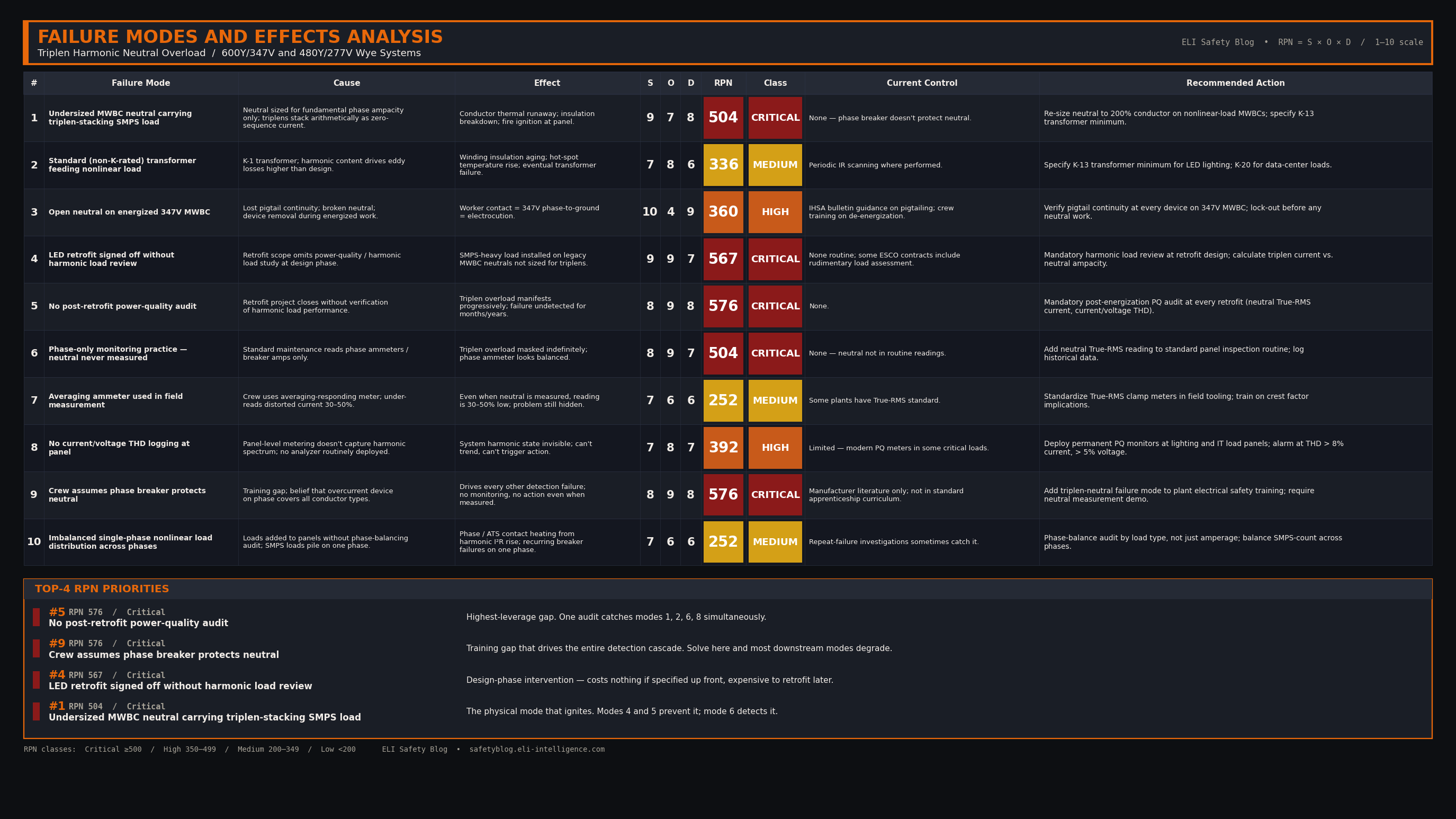
Click the image for full resolution.
7. Field Audit & The Lesson
Specific actions, in order of priority for any E&I professional working on Canadian or US wye systems with nonlinear lighting or electronic loads:
- Measure the neutral with a True-RMS clamp meter. Averaging meters under-read distorted current by 30–50%. If the meter face doesn’t say “True RMS,” it’s lying about your neutral.
- Audit every 347V or 277V lighting panel that has had an LED retrofit in the last ten years. Compare measured neutral current to the conductor’s rated ampacity. This is the highest-probability failure population in commercial and industrial real estate today.
- Log voltage THD at the panel, not just current THD. Voltage distortion above 5% means the system impedance is converting your harmonic current into a problem for every other load on the bus.
- Specify K-rated transformers and 200% neutrals on any new feeder serving heavy nonlinear load — particularly LED lighting panels, server racks, control room UPS feeders, business data systems, and SMPS-heavy production equipment. K-13 minimum for LED lighting; K-20 for data-center-style loads.
- Inventory single-phase 277V VFDs on any 480Y/277V system. They are the US equivalent of the 347V trap and they connect line-to-neutral by design. Push back at mechanical submittal review.
- Audit phase distribution of single-phase nonlinear loads. A breaker or ATS that repeatedly fails on the same phase usually has nothing wrong with the contacts — it has uneven harmonic loading driving I²R heating at the contact interface.
- On split-phase work, verify MWBC wiring at the panel. Both hots on opposite legs. Handle ties present. Brown neutrals are the visible tell.
Take this to the field
The eight actions above are condensed into a printable field checklist — 347V/277V LED Retrofit Neutral Audit Field Checklist. Five sections covering True-RMS measurement procedure, harmonic spectrum capture, conductor and transformer thermal check, and a sign-off block for the work order. Built for E&I professionals walking into a panel where an LED retrofit happened in the last ten years and nobody re-enginered the design for the system to take into account the retrofit.
Download the field checklist (PDF)
The Lesson
The neutral is the quietest conductor in every wye system. It carries the imbalance, it carries the harmonics, and it carries the lessons of every retrofit decision the design team didn’t audit — and unlike every other conductor in the panel, nothing protects it. An energy retrofit that only audits fundamental amperage is half a project. The other half is the harmonic spectrum it leaves behind on a neutral that nobody re-sized.
Reference: The Four Systems
Canadian and US industrial E&I work spans four common low-voltage configurations. The neutral-overload mechanism is different on each.
| System | Where it dominates | Primary neutral overload mechanism |
|---|---|---|
| 600Y/347V (3Ø, 4-wire wye) | Canadian industrial standard — mining, pulp & paper, oil & gas, large commercial | Triplen stacking from 347V LED drivers; shared-neutral MWBC concentration; 347V open-neutral electrocution hazard |
| 480Y/277V (3Ø, 4-wire wye) | US industrial standard; Canadian automotive corridor and US-built imported equipment | Triplen stacking from 277V LED drivers and SMPS loads; 277V single-phase VFD trap on small mechanical loads |
| 208Y/120V (3Ø, 4-wire wye) | Step-down secondaries — control rooms, MCC receptacles, server closets | Classic triplen stacking from 120V single-phase nonlinear loads — same physics, lower voltage |
| 120/240V split-phase (1Ø, 3-wire) | Residential, farms, remote pump houses, light commercial | Miswired MWBC + load imbalance + harmonic mismatch; not zero-sequence on split-phase, but neutrals still cook |
Every wye system carries the same risk. The voltage label changes. The physics doesn’t.
References & Primary Sources
Documented incidents and case studies:
- Technical Safety BC — Electrical fires caused by fluorescent luminaires retrofit with LED tubes
- EC&M Magazine — The Case of Overheated Transformers and Neutral Conductors
- EC&M Magazine — The Case of the Triple Threat (printed-circuit-board manufacturer plug failure)
- Schneider Electric / APC White Paper #38 (Neil Rasmussen) — Harmonic Currents in the Data Center: A Case Study (OneBeacon, Foxboro, MA)
- Eaton — Case Study of Hazards Associated with Neutral Conductors
Regulatory and construction-practice guidance:
- IHSA — 347-Volt Circuits Safety Bulletin
- Electrical Safety Authority (Ontario) — interpretation bulletins on neutral sizing for nonlinear loads
- Alberta Municipal Affairs — STANDATA bulletins on CEC Section 4 nonlinear load provisions
Codes and standards:
- CSA C22.1 — Canadian Electrical Code
- NFPA 70 — National Electrical Code
- IEEE 519 — Recommended Practice for Harmonic Control in Electric Power Systems
- IEEE 142 — Recommended Practice for Grounding of Industrial and Commercial Power Systems (Green Book)
- CSA Z462 / NFPA 70E — Workplace Electrical Safety
Peer-reviewed literature:
- IEEE Transactions — Hazards Associated With Neutral Conductors: A Case Study
- Energies (MDPI, 2026) — Impact of Triplen Harmonics on Neutral Conductor Overheating in Low-Voltage Smart Buildings
Community Discussion
Join the conversation. What are your thoughts on this incident or safety topic?
Comments will appear here once the Giscus GitHub repository is linked.