
Eliminating Trailing Cable Meltdown: Advanced Ground-Fault Relays for Mobile Mining Equipment
Why solid-state NGR monitoring is critical for draglines, shovels, and continuous miners.
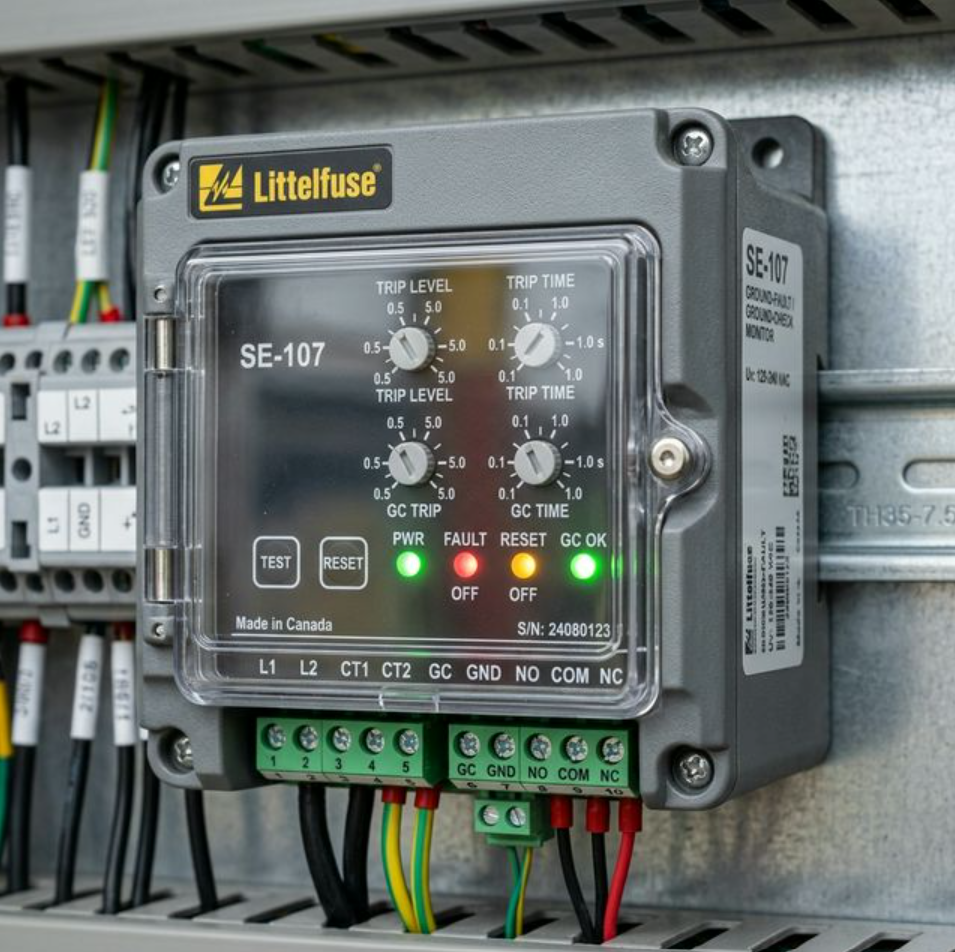
When a continuous miner, dragline, or electric shovel is powered by a high-voltage trailing cable, that cable represents one of the most extreme electrical vulnerabilities on the job site. Subjected to severe abrasion, the crushing weight of rock falls, and constant high-tension reeling, these cables are highly susceptible to sudden insulation failure and violent ground faults.
Standard commercial ground-fault protection schemes are often ill-equipped for this environment. They can fail to detect dangerous high-resistance faults, trip unnecessarily during the massive voltage transients caused by motor starts, or simply break down mechanically due to the intense machine vibration characteristic of heavy mining equipment.
The Solution: Purpose-Built Neutral Grounding Resistor (NGR) Monitoring
Leading electrical safety manufacturers, such as Bender and Littelfuse, engineer advanced Ground-Fault and NGR Monitoring Relays specifically tailored for the harsh realities of surface and underground mining.
These specialized units elevate protection far beyond thermal overload and basic overcurrent:
- Continuous NGR Monitoring: They actively run a diagnostic current through the Neutral Grounding Resistor. If the NGR opens or shorts, the entire trailing cable system loses its safe ground reference—a uniquely deadly condition. Advanced relays instantly trip the primary circuit before a separate phase-to-ground fault has the chance to occur on the ungrounded system.
- High-Resistance Detection: In high-resistance grounded systems (HRG), these solid-state relays can detect incredibly minute leakage currents (often down to milliamperes) that indicate a deteriorating cable splice long before it cascades into a catastrophic arc flash.
- Vibration and Dust Resistance: These relays are built rugged to withstand the relentless shock and vibration profiles of mobile machinery, utilizing conformal-coated circuit boards to protect against highly conductive coal dust and moisture ingress.
The Safety ROI
Upgrading aging protection systems to solid-state, mining-specific NGR relays isn’t just about chasing code compliance. By instantly de-energizing a circuit at the absolute first micro-sign of a high-resistance ground-fault leakage, you are preventing the ignition sequence of a trailing cable fire.
This protects operators who may be handling or walking near the cable, and it saves tens of thousands of dollars in preventing catastrophic equipment burnout. When evaluating your mobile equipment’s electrical architecture, ask your E&I team: “Are we just running standard breakers, or are we actively monitoring the physical integrity of our ground-fault path?”
Community Discussion
Join the conversation. What are your thoughts on this incident or safety topic?
Comments will appear here once the Giscus GitHub repository is linked.