
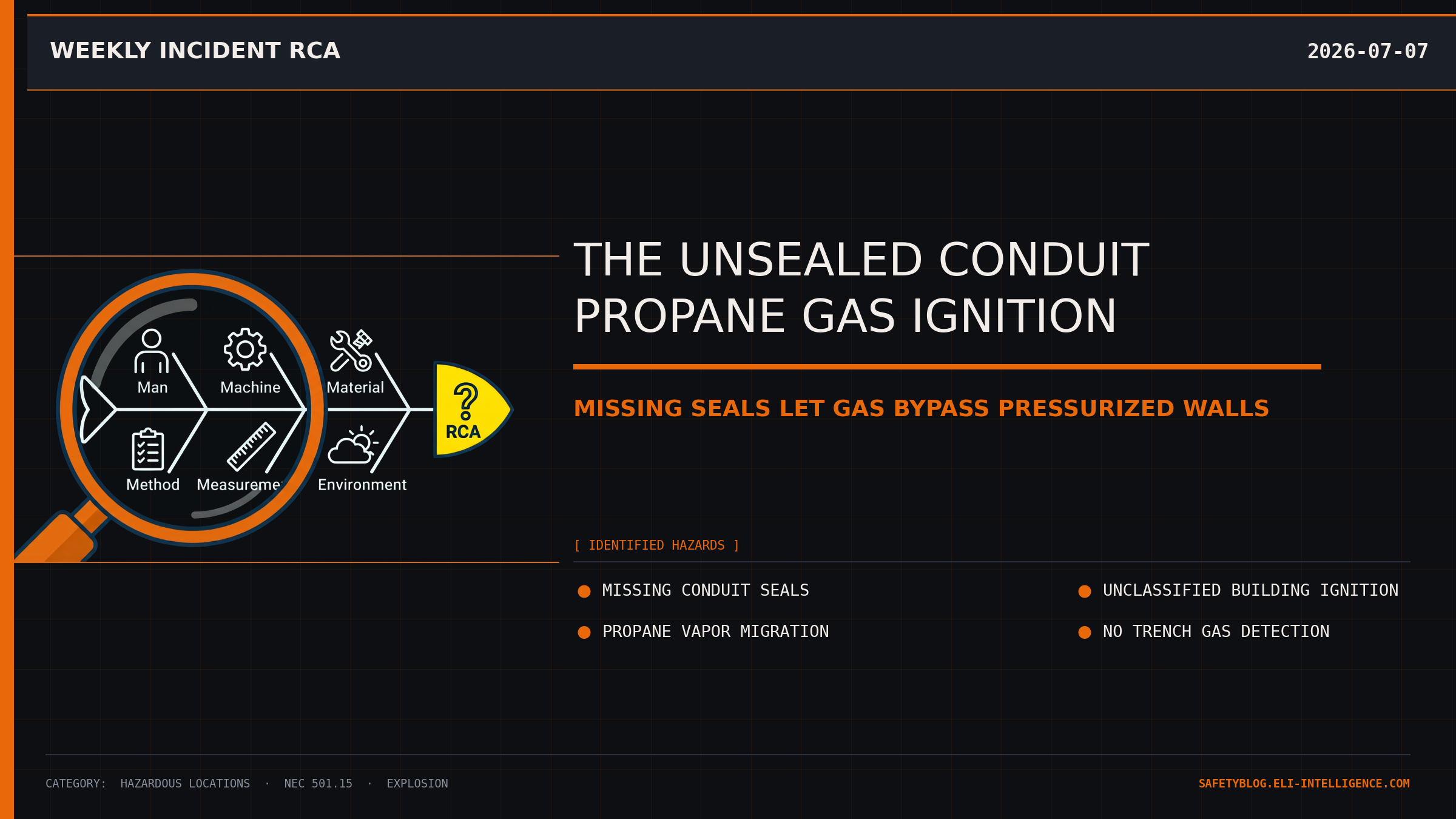
The Unsealed Conduit: Propane Gas Ignition
How a failure to install conduit sealing fittings allowed heavy propane vapor to migrate into an electrical building and ignite.
1. The Hook (Flashpoint)
At 3:05 PM, a blinding fireball and a series of thunderous explosions rocked a petrochemical facility, ripping through a process unit and launching metal shrapnel hundreds of yards. The blast severely burned several operators, shut down the entire chemical plant for months, and resulted in over $50 million in property damage.
2. The Setup
It was a clear, dry afternoon with a steady 12 mph wind blowing across the unit. A maintenance crew was performing operations near a liquid propane storage area. During a transfer operation, a mechanical impact ruptured a liquid propane piping manifold, immediately releasing a high-velocity spray of liquid propane.
The liquid propane vaporized instantly upon contact with the atmosphere, forming a cold, dense, and highly flammable vapor cloud. Because propane vapor is 1.5 times heavier than air, the cloud did not disperse upward; instead, it hugged the ground and began migrating downwind toward a nearby concrete electrical control building (substation). The building housed non-explosion-proof motor starters, PLCs, and heavy-duty 480V air circuit breakers. Although the building interior was designated as an unclassified, safe area, it was surrounded by a Class I, Division 2 process area.
3. The Breakdown
- The Rupture: A piping manifold failed, releasing a massive volume of liquid propane which quickly flashed into a heavy vapor cloud.
- The Migration: The ground-hugging propane vapor cloud spread across the gravel pad, reaching the foundation of the concrete substation building.
- The Boundary Bypass: The substation was pressurized to prevent vapor ingress. However, several underground electrical conduits feeding cables from the outdoor process pumps into the building’s MCC cable trenches lacked conduit sealing fittings (chico seals).
- The Ingress: The heavy propane vapor entered the open ends of the conduits in the process yard and traveled directly through the hollow pipes, bypassing the building’s pressurized walls and emerging directly inside the bottom of the MCC switchgear cable trench.
- The Ignition: As the flammable propane concentration inside the cable trench reached its lower explosive limit (LEL), a routine automatic command from the SCADA system cycled a 480V motor starter. The normal electrical arcing at the contactor tips ignited the trapped propane gas, triggering a powerful explosion that blew the building apart.
4. Interactive Quiz
Guess the Root Cause
Why did the propane vapor manage to enter the pressurized substation building?
5. The RCA
Direct Cause: The direct cause was the ignition of accumulated propane vapor inside the switchgear cable trench by an electrical arc from a standard contactor.
Systemic/Human Cause: The root cause was a failure in electrical design engineering, quality assurance (QA/QC), and code compliance. During a previous expansion project, contractors failed to install explosion-proof conduit sealing fittings at the boundary where conduits exited the Class I, Div 2 area and entered the unclassified building, as mandated by code. The facility’s commissioning and maintenance audits failed to identify these missing seals. Furthermore, there was a systemic lack of awareness among the electrical team regarding the risk of hollow conduits acting as gas migration pathways.
6. Failure Modes and Effects Analysis (FMEA)
(Note: FMEA rendering to be completed by Claude editorial agent prior to publication).

7. Applicable Codes & Standards
- NEC 501.15(B)(2) and 501.15(A)(4) / CEC Section 18-154 — Class I, Division 2 (and Division 1) Boundary Seals: Mandates that a seal be installed in each conduit run passing from a Class I, Division 2 (or Division 1) location into an unclassified location. The sealing fitting must be designed to prevent the passage of gases or vapors.
- NFPA 496 — Standard for Purged and Pressurized Enclosures for Electrical Equipment: Outlines the design requirements for pressurized control rooms, emphasizing that pressurization is ineffective if conduit seals are missing.
- API RP 500 — Recommended Practice for Classification of Locations for Electrical Installations at Petroleum Facilities.
- OSHA 29 CFR 1910.307 — Hazardous (Classified) Locations: Requires that all electrical installations in classified areas meet strict design and sealing standards.
8. Free Resource
[Lead magnet CTA — Claude]
Download the Hazardous Locations Conduit Sealing & Boundary Verification Checklist
9. Actionable Takeaways
- Audit Boundary Conduits: Conduct a comprehensive audit of all conduits entering switchgear rooms, substations, or control rooms from classified process areas. Verify that physical sealing fittings (e.g., Crouse-Hinds EYS) are present and properly filled with compound (Chico).
- Inspect Seal Integrity: Remember that a sealing fitting is useless if it is empty. During turnaround inspections, physically verify that the sealing compound has been poured and has hardened inside the fitting; do not rely on visual inspection of the outer fitting alone.
- Utilize Gas Detection in Trenches: Install combustible gas (LEL) detectors inside substation cable trenches and crawlspaces that connect to process areas. Tie these detectors to the emergency shutdown system to isolate power if gas is detected.
10. Conclusion
Pressurizing a substation to keep out gas is useless if you leave hollow conduits acting as open highways for explosive vapors to enter your switchgear.
Community Discussion
Join the conversation. What are your thoughts on this incident or safety topic?
Comments will appear here once the Giscus GitHub repository is linked.