
Automated Lockout Tagout: Can We Trust a Touchscreen with Our Lives?
Can automated lockout tagout systems match the absolute trust of a physical padlock? We analyze the SIL 3, PL e tech behind Ionic Mechatronics' SafeBox.
Ask any experienced journeyman electrician about automated safety systems, and you will get the same sharp look. The golden rule of industrial electrical safety is simple: “If my personal padlock isn’t directly on the physical disconnect handle, my hands do not go inside the cabinet.” It is a rule written in blood, and for decades, it was the only way to guarantee a zero-energy state.
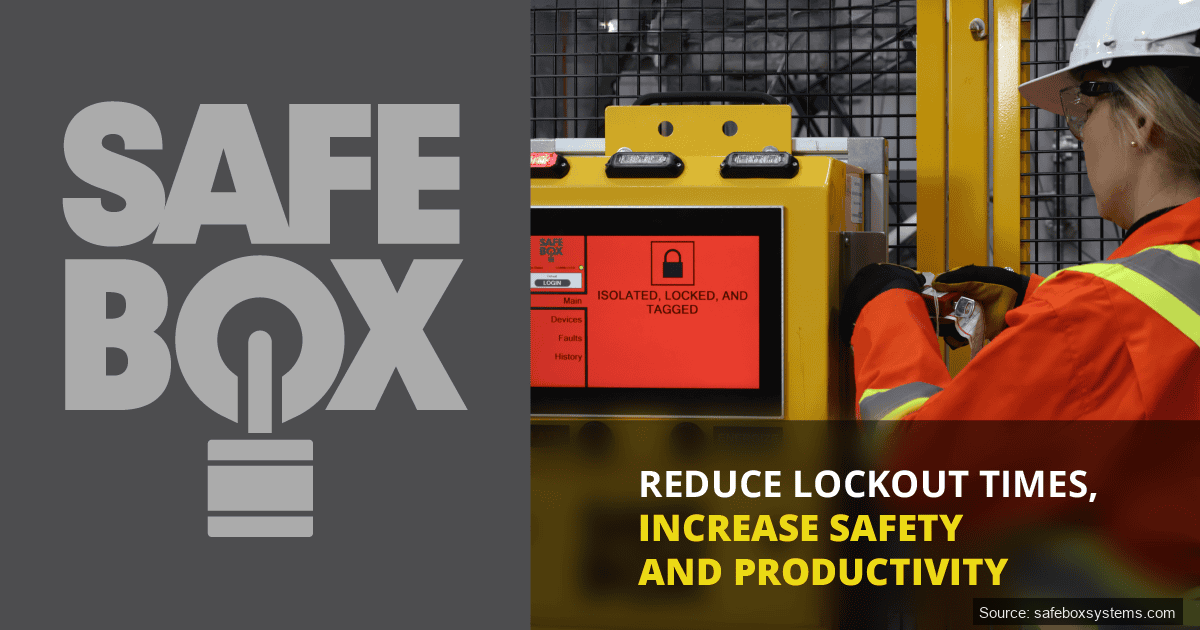
Now, technologies like the Automated Lockout Tagout (LOTO) system—such as the award-winning SafeBox by Ionic Mechatronics—are challenging this traditional mindset. By replacing manual field isolations with centralized, safety-rated digital controls, these systems can isolate dozens of energy sources in seconds. But can a touchscreen really provide the same level of protection as a physical steel lock?
Let’s break down the functional safety engineering that bridges the gap between speed and absolute safety.
The Physics of Skepticism: Why Electricians Trust the Padlock
The resistance to automated lockout tagout is not stubbornness—it is a logical risk assessment. In a traditional manual lockout-tagout procedure, the electrician visually confirms that a knife switch has opened, physically applies a lock and tag, and walks back to verify the zero-energy state.
An automated system, by contrast, relies on interlocks, relays, and PLCs. To a traditional journeyman, a touchscreen command is just a digital suggestion. If a standard PLC processor freezes, a communication bus drops, or a contactor welds shut, a system could easily report a “safe” state while the copper remains energized at 480V or 4160V.
To overcome this skepticism, automated LOTO systems cannot just be “reliable”—they must be mathematically incapable of single-point failure.
The Safety Architecture: SIL 3, PL e, and Category 4
To meet the strict legal requirements of OSHA 1910.147 Control of Hazardous Energy, systems like the SafeBox are engineered to the highest levels of functional safety. They are rated up to SIL 3 (Safety Integrity Level 3), Performance Level e (PL e), and Category 4 (CAT IV).
What does this look like in physical hardware?
- Dual-Channel Redundant Paths: Every safety-critical path is duplicated. If one contactor or safety relay fails to open, the second, independent channel guarantees that power is cut.
- Active Cross-Monitoring: The system’s safety PLC continuously monitors both channels. If a mismatch is detected (e.g., one channel registers open while the other registers closed), the system immediately locks out into a safe state and triggers a critical fault. It cannot be reset until the fault is diagnosed.
- Forced-Guided Contacts: Standard control relays can weld shut under fault conditions. Automated LOTO systems utilize safety relays with mechanically linked, force-guided contacts. If a normally open contact welds, the normally closed contact cannot close, physically preventing the safety PLC from validating a safe state.
Eliminating the LOTO Walk: Speed Meets Systemic Protection
In heavy mining and processing plants, a single conveyor or crushing circuit can span hundreds of feet and require isolating 20 to 50 distinct energy sources—including electrical feeds, hydraulic pumps, and gravity-loaded take-up pulleys.
A manual lockout on this scale is a logistical nightmare. Electricians suffer from “walk-path fatigue,” spending hours traveling between switchrooms and valve stations. This physical demand introduces a high probability of human error, such as locking out the wrong breaker or forgetting a secondary feedback loop.
Centralized LOTO automation solves this by pulling all isolation points into a safety-rated bus. Instead of walking the plant, an operator requests isolation at a central touchscreen. The SafeBox commands all Field Isolation Devices (FIDs) to actuate, verifies the zero-energy state at each point, and then allows the technician to apply their personal padlock to a single lockbox on the Master Control cabinet.
A procedure that once took two hours is completed in under 60 seconds—without compromising a single safety margin.
The Ultimate Benefit: Getting Out of the Arc Flash Boundary
Beyond speed, the single greatest benefit of automated LOTO is the reduction of arc flash exposure.
In a traditional plant, an electrician must stand directly in front of an electrical enclosure to operate the physical disconnect handle. If a line-side fault occurs during the throw, the electrician is positioned directly in the line of fire for a catastrophic arc flash.
By automating the physical throws, the SafeBox keeps your team completely outside the arc flash boundary. The isolation is completed remotely, and the zero-energy state is verified electronically before anyone ever approaches the high-voltage cabinets.
Centralized automation does not replace the discipline of safety—it standardizes it. By pairing SIL 3 redundancy with single-point padlocking, heavy industry is proving that we can speed up LOTO operations while making them safer than ever before.
Community Discussion
Join the conversation. What are your thoughts on this incident or safety topic?
Comments will appear here once the Giscus GitHub repository is linked.